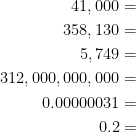
Question: How is negative power related to fraction (division)?
\text{Write the expressions without exponents} \\
\begin{aligned}
&3^3x^2y^4z^6 \ =\ \\
&(a+b)^3 \ =
\end{aligned}
3. Comparing with exponents
Hint: write big numbers in scientific notation, then compare.
\begin{aligned}
943,260,000,000,000,000,000,000 = \\
8,720, 000,000,000,000,000,000,000 = \\
\end{aligned}
\\
\text{Question 1: how many digits in each section separated by commas? } \\
4. Scientific notations
N \times 10^a \text{ where } 1 \leq N \lt 10 \\
1) Write each number in scientific notation
2) Write each number given in scientific notation in normal form.
Picture a cat stalking a mouse. They’re about 100 inches apart. Every time the mouse starts nibbling at the hunk of cheese, the cat takes advantage of the mouse’s distraction and creeps closer by one-tenth the distance between them. The cat wants to get about 6 inches away – close enough to pounce. How far apart are they after four moves? How about after 10 moves? How long will it take before the cat can pounce on the mouse?
Mouse ——– 100 inches———–Cat
Mouse ——- 90 inches —— Cat
Mouse ——81 inches — Cat
Mouse — 72.9 inches — Cat
Mouse — 65.61 inches – Cat
Find the total distance that a super ball travels if it always bounces back 75 percent of the distance it fell. You dropped it from a window that’s 40 feet above a nice smooth sidewalk. Assume that the ball always falls straight down and returns straight up.
A \times (1-r) = A - A \times r. \text{. (Distributive property)} \\
(1+ r + r^2 + r^3 + ... ) \times (1-r) \\
= (1+ r + r^2 + r^3 + ... ) - r (1+ r + r^2 + r^3 + ... )
\\
= (1+ r + r^2 + r^3 + ... ) - r -r^2 - r^3 - ...
\\
=1
\\
\Rightarrow (1+ r + r^2 + r^3 + ... )
=\frac{1}{1-r}
A geometric sequence is formed when each term is found by multiplying the previous term by a particular number, called the ratio.
\text{The sum of the terms of an infinite geometric sequence: } \\
Sum = \frac{a}{1-r}. \text{where} 0 \lt r \lt 1 \\
\text{The sum of the first n terms of any geometric sequence: } \\
Sum = \frac{a \times (1-r^n)}{1-r}. \text{where} 0 \lt r \lt 1